
SMMU Software Architectural Design (SWE.2)
Note: The images in this document were generated using AI.
1 Module Overview
1.1 Purpose of Module
The SMMU Software Architectural Design defines the high-level structure and components of the SMMUv3 driver. It bridges the gap between software requirements (SWE.1) and detailed design (SWE.3), ensuring the system is robust, performant, and maintainable.
1.2 Role of Module
The SMMU module acts as the IOMMU driver for ARM64 systems. Its primary roles are:
- Translation Management: Managing Page Tables (Stage 1/2) for DMA address translation.
- Isolation: Enforcing access control by ensuring devices can only access mapped memory.
- Hardware Abstraction: Encapsulating SMMUv3 hardware details (Queues, Tables) from the generic IOMMU subsystem.
- Fault Reporting: Catching and reporting DMA faults (e.g., translation errors) to the kernel.
1.3 Boundary of Module
- Interfaces: Interacts with the Linux IOMMU Subsystem (upper layer), ACPI/Device Tree (configuration), and SMMUv3 Hardware (lower layer).
- Scope: Covers
arm-smmu-v3.c,io-pgtable-arm.c(interaction), and associated headers. - Exclusions: Does not include the core Logic of the PCI subsystem or the generic IOMMU API itself.
2 Module Architecture
2.1 Implementation View
The implementation view shows the static code structure and file organization.
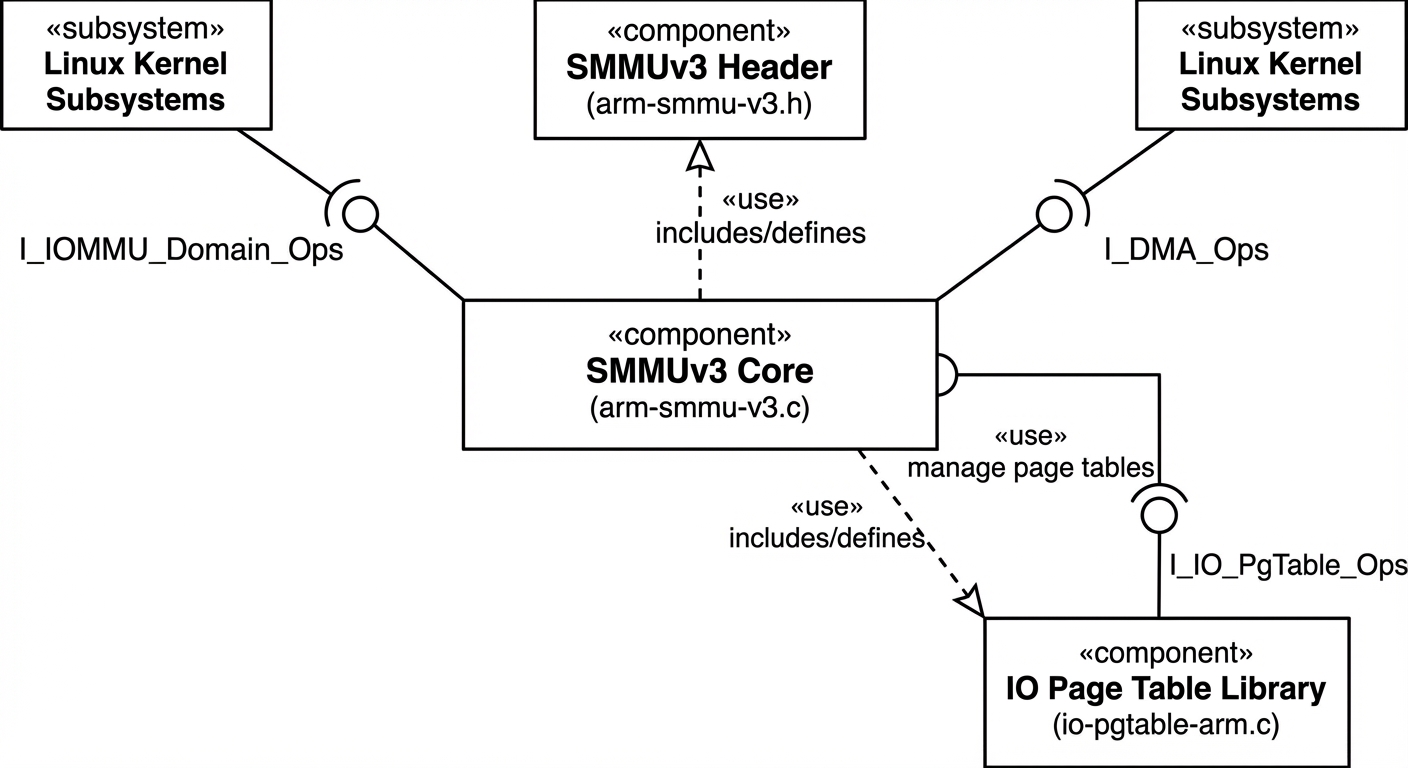
Role of Implementation elements
| Implementation Element | Role |
|---|---|
SMMUv3 Core (arm-smmu-v3.c) |
Main driver logic: Initialization, Queue Management, Command Issue. |
IO Page Table (io-pgtable-arm.c) |
Helper library for manipulating ARMv8/LPAE page table formats. |
SMMUv3 Header (arm-smmu-v3.h) |
Defines hardware register offsets, queue entry formats, and macros. |
2.2 Runtime View
The runtime view illustrates the dynamic behavior and interaction of objects during execution.
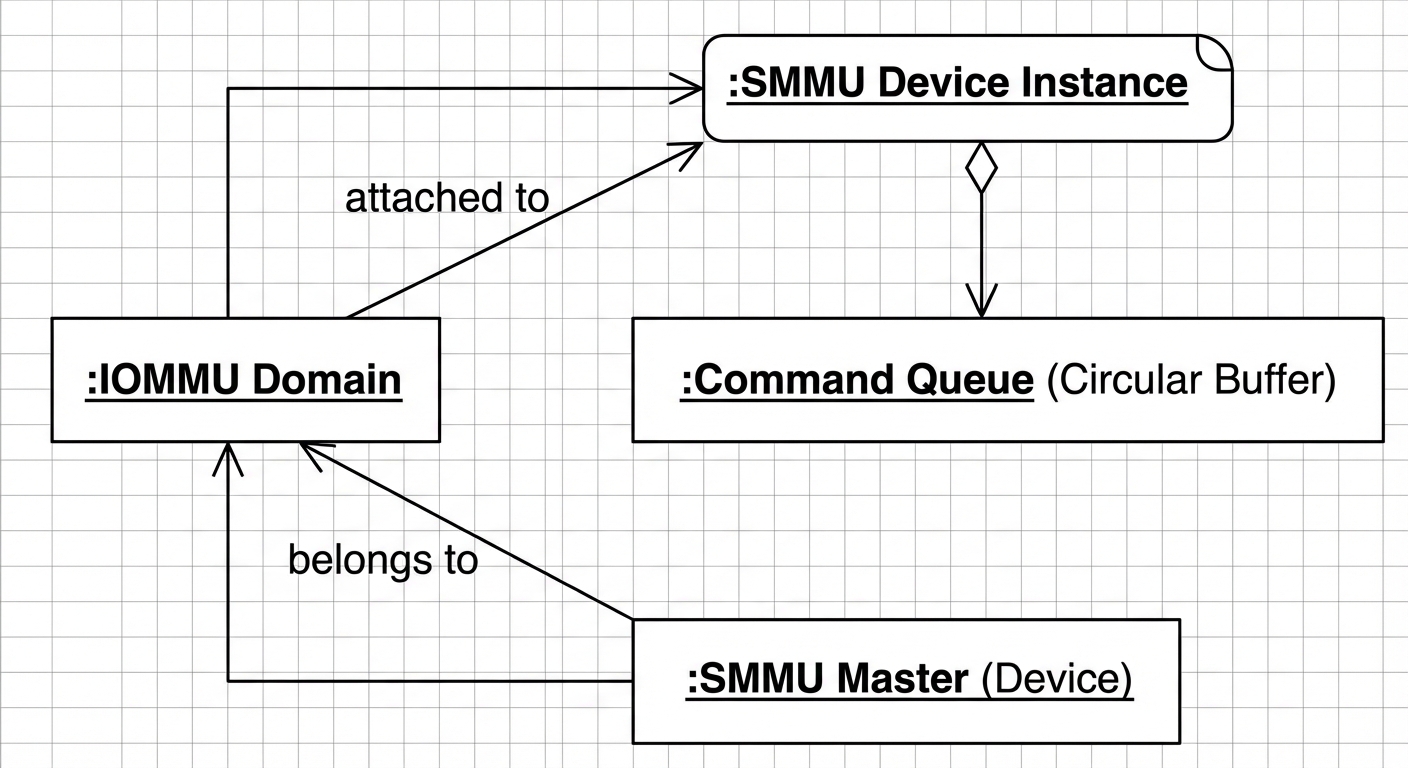
Role of runtime elements
| Runtime Element | Role |
|---|---|
SMMU Device (arm_smmu_device) |
Represents a physical SMMUv3 hardware instance. |
SMMU Domain (arm_smmu_domain) |
Represents an abstract IOMMU domain (container for mappings). |
Master Device (arm_smmu_master) |
Represents a client device (e.g., PCIe EP) attached to the SMMU. |
| Command Queue | Ring buffer for sending commands (TLBI, SYNC) to hardware. |
Role of connector
| Connector | Role |
|---|---|
| IOMMU Ops | iommu_ops function table called by the generic IOMMU layer. |
| MMIO | Memory-Mapped I/O for register access. |
| DMA | Direct Memory Access for Queue consumption by hardware. |
Runtime-to-Implementation Mapping
| Runtime View Elements | Implementation View Elements |
|---|---|
| SMMU Device | struct arm_smmu_device in arm-smmu-v3.c |
| SMMU Domain | struct arm_smmu_domain in arm-smmu-v3.c |
| Page Table Ops | struct io_pgtable_ops in io-pgtable-arm.c |
2.3 Allocation View
The allocation view maps software components to hardware units.
- SMMU Driver: Runs on the CPU, managing system memory structures (Tables, Queues).
- Hardware Unit: The SMMUv3 hardware fetches commands from memory and performs translations using cached TLBs and the in-memory Stream/Page Tables.
3 Module Interaction
3.1 Interaction: DMA Mapping & TLB Invalidation
This interaction describes the process when a driver maps a buffer for DMA.
Map and Invalidate Sequence
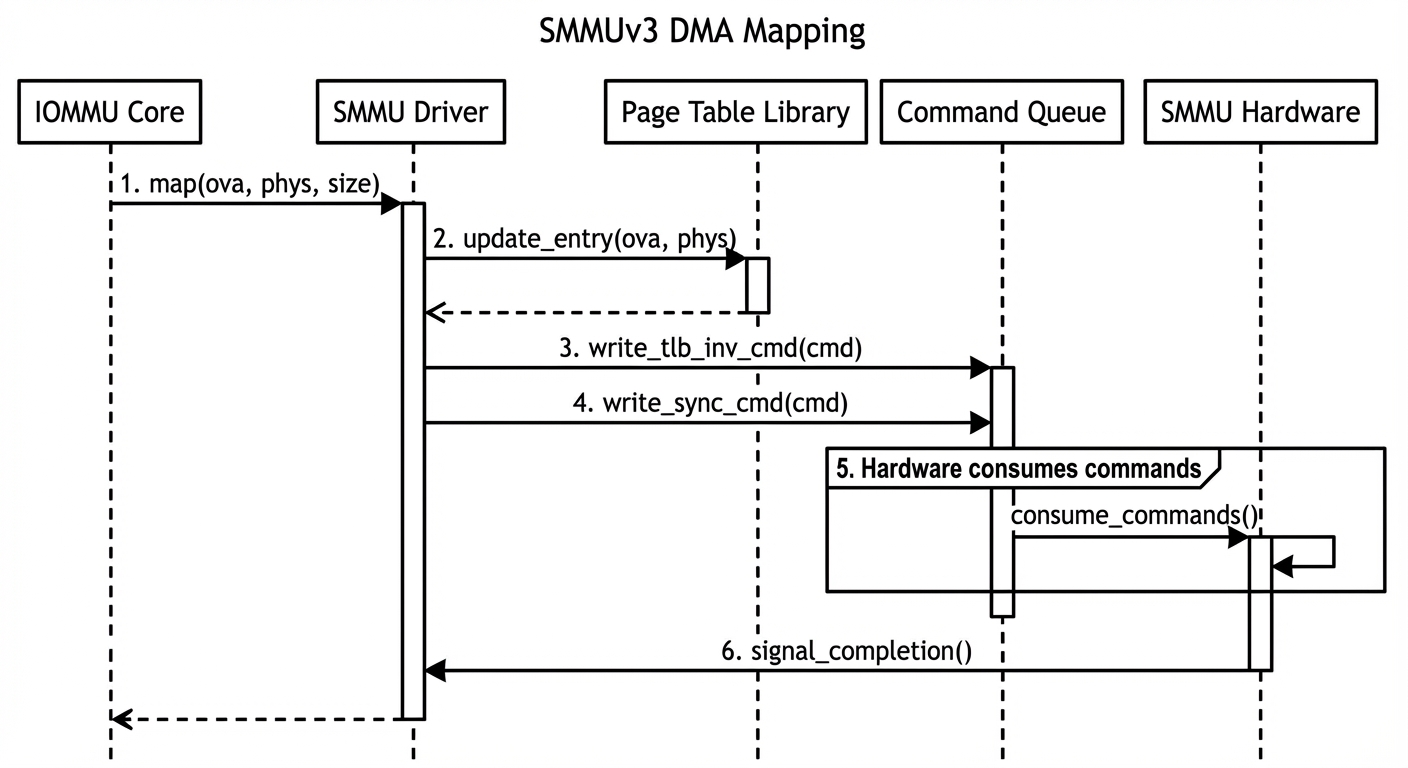
Flow:
- Device Driver calls
dma_map_single(). - IOMMU Subsystem calls
arm_smmu_map(). - SMMU Driver updates Page Table (via
io-pgtable). - SMMU Driver issues
CMD_TLBIto Command Queue. - SMMU Driver issues
CMD_SYNCand polls for completion.
4 Annex
4.1 Annex A. Alternative Architecture
4.1.1 Strict vs. Lazy Mode
- Strict Mode: Issue TLB Invalidation (and Sync) immediately after every unmap. Secure but slower.
- Lazy Mode: Defer TLB Invalidation until a threshold is reached or memory is reused. Faster but less secure (theoretical window for use-after-free).
- Selection: The driver supports both, configurable via kernel command line. Default is Strict for safety/security.
4.2 Annex B. Alternative Architecture Evaluation
| ID | Quality Attribute | Score | Reason for Evaluation | | :— | :— | :— | :— | | Alt-01 | Performance | High | Lazy mode significantly improves throughput for high-churn workloads. | | Alt-02 | Security | Low | Lazy mode leaves stale TLB entries window. | | Evaluation Result | Adopt (Configurable) | Allow users to choose based on system requirements (Safety vs. Perf). |
4.3 Annex C. Selected Architectural Design
The selected design uses a Queue-Based Command Interface with support for Strict Mode by default.
- Justification: Aligns with the ARM SMMUv3 specification and prioritizes correctness and isolation (Safety) over raw throughput, while retaining flexibility.
5 Terms and Abbreviations
| Terms and Abbreviations | Description |
|---|---|
| TLBI | TLB Invalidate |
| IOVA | Input Output Virtual Address |
| LPAE | Large Physical Address Extension |
| STE | Stream Table Entry |
6 References
| Documents Name | Version |
|---|---|
| SMMU Software Requirements Specification (SWE.1) | 1.0 |
| Linux Kernel Documentation (iommu) | 6.12 |
Leave a comment